


Scoliosis
WHAT IS SCOLIOSIS?
Symptoms
When significant enough, it is associated with uneven appearance of the shoulders and/or hips, uneven appearance of the shoulder blades, or prominence of the ribs (“rib hump”), often most noticeable when bending over forward.
Many patients have no other symptoms, but in advanced cases or when another underlying condition is involved, patients may have a wide variety of problems including back pain, leg numbness/tingling or weakness, bladder symptoms, compromise of heart or lung function, etc.
Some patients do not get worsening over time (“stable”), while others develop increasing symptoms or curvature over time (“progressive”).
Diagnosing
The diagnosis of scoliosis may be made by your child’s school nurse. The nurse generally uses the Adam’s Forward Bending Test, which has the child bending forward at the waist and reaching his or her arms straight outward. Abnormalities such as a protruding rib or an abnormally shaped back may be seen. Scoliosis can also be diagnosed during routine pediatric exams.
The physician will examine the spine, hips, shoulders, and legs to assess for signs of scoliosis. If scoliosis is suspected, X-rays may be ordered to confirm the diagnosis and determine the severity of the spinal curvature. A child’s scoliosis is determined by the shape, size, direction, location, and angle of the curve.
Adult scoliosis is often diagnosed with X-rays taken during a search for the cause of back or leg pain. Scoliosis may also be diagnosed when an X-ray is taken for an unrelated issue and the radiologist notices scoliosis on the X-ray.
Treatments
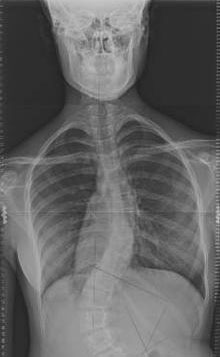
There are many different types of scoliosis, which are often evaluated and treated differently:
- Idiopathic Scoliosis presents most often in adolescence (age 10-17). It affects girls much more than boys and is passed down in families. There are also rarer forms that present before age 10 and this form is not secondary to another condition.
- Neuromuscular Scoliosis refers to scoliosis that is secondary to some sort of neuromuscular condition or syndrome. Common ones would include cerebral palsy, myelodysplasia, muscular dystrophy, polio, spinal cord injury, etc.
- Degenerative Scoliosis is an adult-onset form that occurs secondary to the development of degeneration of the spine and its joints. This is most common after the age of 50.
- Congenital Scoliosis is caused by abnormal development of vertebra, present at birth. Sometimes vertebrae fail to form normally, or they can fail to segment from each other, leading to an abnormal curvature of the spine. This form can be noticeable at any age in childhood.
- For children, treatment options for scoliosis are based on age, gender, and the location and severity of the curve. The curvature is monitored closely and, if necessary, managed with bracing.
- Bracing does not cure scoliosis, but it may impede the further progression of the curve. If the curve advances despite conservative measures or the measurement of the curve are greater than 40° to 50°, surgical correction is often considered.
- With adult scoliosis, treatment planning is generally based on the severity of pain and functional limits. Because of the malalignment of the spine, pain may arise from the facet joints, sacroiliac joints, or from nerve root compression.
- The pain from these conditions is managed with physical therapy, medication, facet injections, sacroiliac joint injections, or epidural steroid injections. If pain persists or physical function is significantly limited, surgery may be considered.
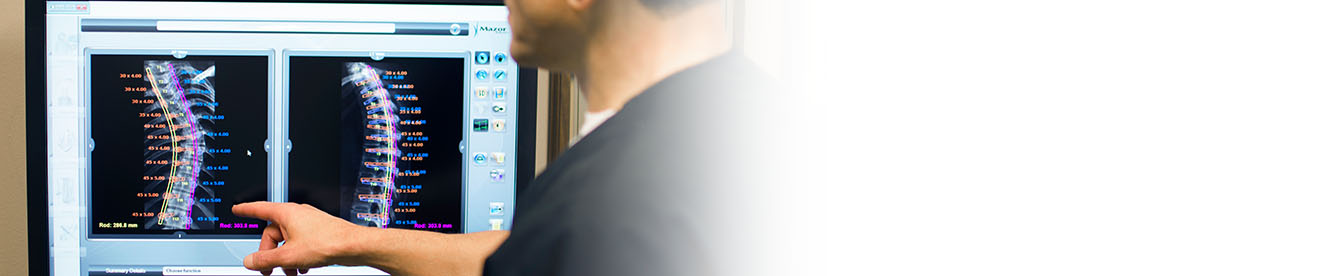
Posterior lumbar fusion (PLF), combined with pedicle screws and rods, is used to re-align the spine. Sometimes, anterior lumbar interbody fusion (ALIF) is also done to create a 360° fusion (fusing the front and back portions of the spine).
Treatment options include:
-
- Watchful waiting with serial observation of the curve
- Exercise & physical therapy
- Bracing
- Anti-inflammatory medications
- Surgery
Frequently Asked Questions
In cases where the curvature is severe or does not respond to bracing, surgery may be recommended. At Texas Back Institute, experienced surgeons on the medical staff perform surgery using the most appropriate, innovative, and least invasive spine surgery techniques. Less invasive surgery offers more cosmetically acceptable scars, a shorter hospital stay, and a quicker recovery.
Surgery for scoliosis involves correcting and balancing the curve and fusing the bones in the curve together. The bones are held in place with one or two metal rods held down with hooks and screws until the bones knit themselves solid.
Rehabilitation for surgical patients is designed to help them get back to their lives as quickly as possible. With some of the most experienced and qualified therapists in the area, advanced facilities, and personalized, one-on-one therapy sessions.
An evaluation by a spine surgeon is the best way to get an accurate answer to that question. An evaluation by a spine surgeon with special interest and expertise in scoliosis is your best bet. If you have a concern, we would be happy to evaluate your child.
Yes and no. While it is not an emergency, we occasionally see patients who would have been treatable with a brace if diagnosed earlier but have a surgical curve the first time they are seen.
While a few days or weeks may not be critical, a few months or a year might make a difference for certain patients. This will not be true for everyone, but it’s hard to figure out in a given case without seeing the patient.
Not usually. If you have a curve that is not severe (less than 50 degrees), then you should not expect to have severe problems or pain, at least not much more than the average person who does not have idiopathic scoliosis.
Generally, idiopathic curves are not thought to cause severe pain complaints. Because of this, if a patient with a curve complains of significant pain, we usually begin to look for another cause to explain the pain, rather than blame it on the curve.
This would be very, very rare. There are other, non-idiopathic types of curves (congenital, neurofibromatosis) that more commonly could lead to paralysis, so it is important to be evaluated by a spine deformity specialist if you have a significant curve to ensure that an underlying, more serious condition is not overlooked.
It is very possible. At the Texas Back Institute, many patients that have surgery for spinal deformity have had one or more previous surgeries elsewhere. This comes with additional challenges but is commonly still treatable with success.
Not necessarily. Age is only one factor that we will analyze to decide if surgery is reasonable to consider. Other factors include your other medical history, what surgery would be required, bone density, physical fitness, etc.
There are patients in their 80s who could have such surgery safely, and there are unhealthy patients in their 40s that we would not consider even a simple elective procedure because of the relative risk.
Yes. Your risk of having it is higher if you have a sibling or parent with it. So siblings of scoliosis patients should be at least looked at when appropriate. What is inherited is the tendency to have a curve, but not necessarily the severity of the curve pattern.
There are families with curves of all different magnitudes and patterns, including identical twins with vastly different x-rays. Just because one needed surgery, doesn’t mean the other family members will, and just because one didn’t need surgery doesn’t mean the others won’t.
These things are not thought to cause a curve, nor do they cause it to get worse. The overwhelming factor is genetic in idiopathic scoliosis.
Generally, there is seldom a reason to restrict sports if you have an idiopathic curve. There may be certain details that your doctor might factor into their answer to your question in your specific situation.
It depends on the details of your surgery, which sport, etc. You should ask your surgeon who will have to weigh many factors in considering the answer to this question. Many patients are able to participate in sports normally after they are recovered from surgery.
Most of the time for adults, yes. Adults have different curve types that more commonly involve the lower lumbar levels, and they have different biology/bone quality/potential for healing than teenagers, which usually necessitates this extra step.
In some cases, there are techniques that are less invasive than others for performing the anterior fusions. There are exceptions to this answer, so you should get additional opinions if it is not clear to you.
Not usually. The instrumentation holds the spine while healing occurs. While it may be possible to remove the implants after the fusion is healed, this is generally not done unless a specific reason arises in the future.
Yes! At the Texas Back Institute, you will find leaders in all manners of spine and spinal deformity surgery, including in the most innovative minimally invasive, navigated, robotic and traditional surgical techniques.
Many patients are candidates for less-invasive approaches for their spinal deformities. Please come see us to find out if it is right for you.